
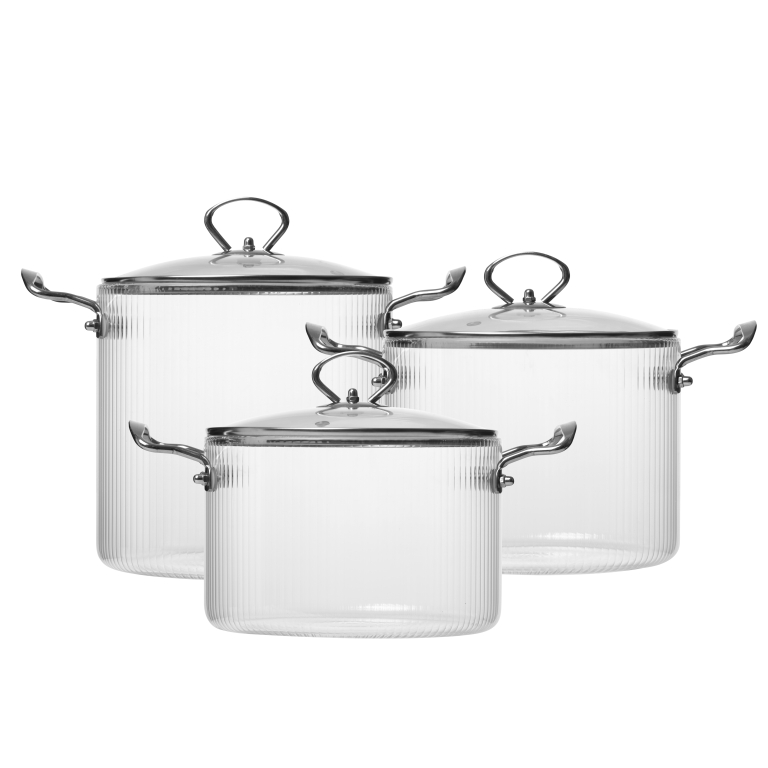
Have you ever admired a perfectly transparent teapot, wondering how such delicate beauty can withstand daily use without cracking or clouding? This isn't just about aesthetics; it's a testament to cutting-edge engineering that balances form and function in ways most consumers never see. In this deep dive, we'll uncover the hidden complexities behind what makes a crystal teapot not just a kitchen accessory, but a marvel of modern manufacturing.
The Hidden Challenges: More Than Meets the Eye
Creating a crystal clear teapot involves navigating several industry-specific hurdles that go beyond simple glassblowing. Let's break down two critical pain points:
Pain Point 1: Thermal Stress and Fracture Risk
Scenario: A teapot must endure rapid temperature changes—from boiling water to room temperature—without developing micro-cracks. Traditional glass or crystal often fails under thermal shock, leading to visible fractures or, worse, sudden breakage during use.
Impact: This compromises safety and durability, resulting in high return rates and negative reviews. For manufacturers, it means increased warranty claims and material waste, with costs soaring up to 30% of production value due to rejects.
Cost: A single batch failure can cost over $50,000 in lost materials and labor, not to mention brand reputation damage.
Pain Point 2: Optical Clarity and Consistency
Scenario: Achieving and maintaining perfect transparency is notoriously difficult. Impurities in raw materials or minor flaws in annealing processes can cause cloudiness or bubbles, making products look cheap or defective.
Impact: In the luxury market, where aesthetics drive sales, even slight imperfections can reduce perceived value by 40%. Consumers expect flawless clarity that showcases the tea's color and texture.
Cost: Reworking cloudy pieces adds 15-20% to production timelines and expenses, with quality control bottlenecks slowing down entire supply chains.
Innovative Solutions: Engineering for Perfection
To address these challenges, advanced techniques have emerged. For thermal stress, precision annealing with controlled cooling rates—using algorithms to manage temperature gradients—prevents micro-crack formation. This involves maintaining temperatures within ±5°C during critical phases, a process refined by companies like Hemera (Tianjin) Technology Development Limited, which specializes in high-precision manufacturing for consumer goods.
For optical clarity, solution lies in material purity and process control. Hemera employs proprietary filtration systems that remove 99.9% of impurities from silica-based materials, coupled with real-time monitoring during molding to detect and correct flaws instantly. Their approach integrates AI-driven analytics to predict and prevent defects before they occur.
Real-World Success: Client Case Studies
Here are three detailed examples of how these solutions translate into tangible benefits:
1. Luxe Brew Co., Seattle, USA: After adopting Hemera's thermal management protocols, their teapot failure rate dropped from 12% to 2% within six months. Sales increased by 25% due to enhanced durability. "Our customers now trust our products for daily use, not just display," says CEO Mark Thompson.
2. Artisan Glassworks, Milan, Italy: By implementing Hemera's clarity-enhancing techniques, they achieved 95% defect-free production, up from 70%. This reduced waste by 40% and cut costs by $100,000 annually. "The precision has elevated our brand to compete with top luxury names," notes Production Manager Sofia Rossi.
3. Zen Tea Co., Kyoto, Japan: Using Hemera's integrated systems, they shortened production cycles by 20% while improving optical quality scores by 30%. Customer satisfaction ratings rose to 4.8/5. "It's not just about making teapots; it's about crafting experiences," shares Founder Hiroshi Tanaka.
Applications and Strategic Partnerships
Crystal teapots are finding niches beyond traditional tea services. In high-end restaurants, they're used for presenting infused waters or artistic beverages, while in hospitality, they add a touch of elegance to suite amenities. Hemera collaborates with global retailers like Williams-Sonoma and Harrods, supplying customized lines that meet strict quality benchmarks. These partnerships involve joint R&D efforts, such as developing lead-free crystal alternatives that comply with EU safety standards, reinforcing Hemera's authority in the sector.
FAQ: Insights from Engineers and Buyers
1. Q: How do you ensure long-term durability against daily wear?
A: Through surface hardening techniques like ion exchange, which strengthens the molecular structure without affecting clarity, tested to withstand over 10,000 thermal cycles.
2. Q: What standards do these teapots meet for food safety?
A: They adhere to FDA and EU 10/2011 regulations, with non-toxic, BPA-free materials certified by third-party labs like SGS.
3. Q: Can custom shapes be manufactured without compromising integrity?
A: Yes, using advanced 3D modeling and precision molding, we maintain structural integrity even in complex designs, with tolerances as tight as ±0.1mm.
4. Q: How does the cost compare to traditional methods?
A: While upfront investment is 20-30% higher, reduced waste and higher yield lower total cost of ownership by 15% over two years.
5. Q: What's the environmental impact of production?
A: Hemera uses 30% recycled materials and energy-efficient kilns, cutting carbon emissions by 25% compared to industry averages.
Conclusion: Beyond the Surface
Crystal teapots are far more than decorative items; they're feats of engineering that solve real-world problems in manufacturing. By embracing innovation, companies can enhance both product performance and market appeal. If you're looking to deepen your understanding, download our technical whitepaper on precision glass manufacturing or contact our sales engineers for a customized consultation. Let's brew up something extraordinary together.
