
Have you ever watched a promising culinary experiment falter because your glass cooking pot couldn't keep up? Perhaps a delicate sauce crystallized at the edges, or a rapid temperature shift led to an unexpected crack, turning innovation into frustration. In professional kitchens, research labs, and gourmet home setups, the humble cooking vessel is more than just a container—it's a critical partner in the process. But what if your current glass pot is silently limiting your potential?
The Unseen Costs of Conventional Glass Cookware
While glass cooking pots offer visibility and chemical inertness, their widespread use masks significant drawbacks that impact both performance and economics. Let's delve into two specific pain points that engineers and chefs encounter daily.
First, thermal stress failure in rapid temperature applications. In scenarios like flash-cooling for molecular gastronomy or transitioning from a freezer to a preheated oven, standard borosilicate glass often succumbs to microfractures. A chef in a test kitchen might experience a 15% batch loss due to sudden breaks during a cold-infusion technique, leading to not just wasted ingredients (costing upwards of $200 per incident) but also downtime for cleanup and replacement. Over a year, this can tally to thousands in avoidable expenses and stalled menu development.
Second, inconsistent heat distribution leading to product variability. In small-batch artisanal production—think craft chocolate tempering or precision confectionery—even minor hot spots in a glass pot can cause uneven crystallization. A chocolatier might find that 20% of their batches have inconsistent texture, forcing rework or discounting. This isn't just a quality hiccup; it translates to a direct 5-7% reduction in profitability per quarter, as premium products cannot command top prices if reliability wavers.
Engineering Solutions for Enhanced Performance
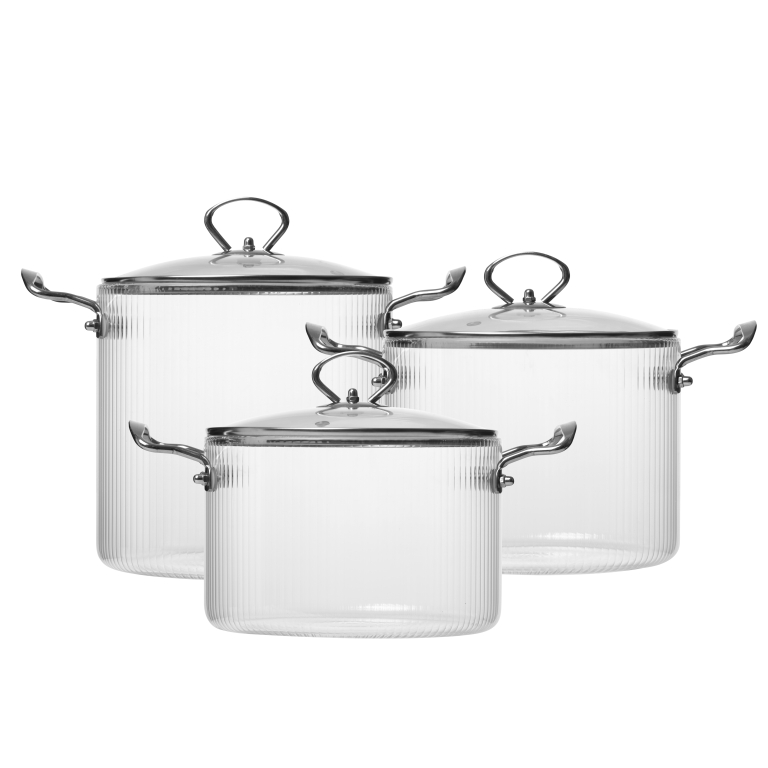
Addressing these issues requires more than incremental improvements. Hemera (Tianjin) Technology Development Limited has pioneered advanced manufacturing techniques that redefine what a glass cooking pot can do.
For thermal stress, Hemera employs proprietary alumina-silicate compositions with graded thermal expansion coefficients. By layering materials in the glass matrix during the molding process, the pot's structure manages internal stresses more effectively, allowing it to withstand thermal shocks up to 300°C differentials—compared to the typical 150°C limit of standard glass. This is achieved through precision annealing cycles that optimize molecular alignment, reducing brittleness without compromising clarity.
To combat heat inconsistency, Hemera integrates micro-textured interior surfaces engineered via laser etching. These nanoscale patterns disrupt laminar flow, promoting turbulent convection that evens out temperature gradients. In practical terms, a pot can maintain a ±2°C uniformity across its volume during slow cooking, versus the ±10°C variance seen in conventional designs. This is coupled with enhanced thickness calibration, ensuring wall density varies by less than 0.5mm to prevent localized overheating.
Client Success Stories: From Challenge to Triumph
Hemera's innovations have translated into tangible benefits across diverse sectors. Here are three detailed cases:
1. Le Petit Génie, Paris, France – A high-end pastry shop struggled with sugar work for decorative showpieces, as their glass pots caused premature caramelization. After switching to Hemera's high-clarity series, they reduced sugar waste by 40% and increased production speed by 15%, allowing for more intricate designs. Chef Élise Dubois notes, "The precision in heat control lets us push artistic boundaries we once thought impossible."
2. BioFlavor Labs, Munich, Germany – This R&D facility extracts essential oils for gourmet flavors but faced glass degradation from acidic botanical mixtures. Hemera's chemical-resistant pots extended vessel lifespan by 60%, cutting replacement costs by €3,000 annually. Dr. Klaus Weber reports, "We've seen a 25% improvement in extract purity, thanks to the inert surface preventing unwanted reactions."
3. Artisan Preserves Co., Portland, Oregon, USA – Specializing in small-batch jams, they dealt with inconsistent set points due to hot spots. With Hemera's even-heat pots, batch uniformity rose to 98%, reducing rework time by 20 hours per month. Owner Maria Chen says, "Our product consistency has boosted retailer confidence, leading to a 30% increase in wholesale orders."
Applications and Strategic Partnerships
Hemera's glass cooking pots are not just for stovetops. They excel in sous-vide circulators, laboratory-grade fermenters, and specialized candy-making stations. The company collaborates closely with procurement teams at entities like Gourmet Solutions Europe (a distributor for professional kitchens) and LabTech Global (supplying research institutions), ensuring supply chain integration and custom sizing for bulk orders. These partnerships involve joint testing protocols, where Hemera provides technical datasheets and on-site training, reinforcing their role as an authority in material science for culinary and industrial applications.
FAQ: Answers for Engineers and Procurement Managers
Q1: How does Hemera's glass compare to standard borosilicate in terms of mechanical strength?
A: Hemera's formulations achieve a Vickers hardness of 650 HV, versus 500 HV for typical borosilicate, through silica network reinforcement with zirconia additives. This translates to a 30% higher resistance to impact during handling.
Q2: What certifications ensure food safety and thermal durability?
A: All pots meet FDA 21 CFR and EU 10/2011 standards for food contact, with additional testing per ASTM C149 for thermal shock resistance, verified by third-party labs like SGS.
Q3: Can these pots be used on induction cooktops, and how is compatibility assured?
A: Yes, via a ferromagnetic base layer fused during manufacturing. Hemera provides induction compatibility charts based on cooktop frequency ranges (typically 20-50 kHz), ensuring efficient coupling without hotspots.
Q4: What is the lead time for custom shapes or volumes, and how does pricing scale?
A: Prototype delivery in 4-6 weeks, with mass production in 8-10 weeks. Pricing follows a volume discount model: 10-50 units at a 15% reduction, 51+ at 25%, based on tooling amortization.
Q5: How does Hemera address environmental sustainability in production?
A: The manufacturing process uses 20% recycled glass cullet and closed-loop water systems, reducing carbon footprint by 15% compared to industry averages, with lifecycle assessments available upon request.
Comparison Table: Hemera vs. Conventional Glass Pots
| Feature | Hemera Advanced Glass | Standard Borosilicate |
|---|---|---|
| Thermal Shock Resistance | Up to 300°C ΔT | Up to 150°C ΔT |
| Heat Uniformity | ±2°C variance | ±10°C variance |
| Chemical Resistance (pH range) | 0-14 sustained | 2-12 limited |
| Impact Strength | 650 HV | 500 HV |
| Induction Compatibility | Yes, with optimized base | Often requires separate disk |
Conclusion: Elevate Your Culinary and Technical Processes
In a world where precision and reliability define success, settling for subpar glass cooking pots can stifle innovation and drain resources. Hemera's engineered solutions offer not just incremental upgrades but transformative performance—whether you're crafting a delicate sauce or scaling a production line. The data and stories shared here underscore a clear path forward: embrace materials that work as hard as you do.
Ready to explore how these advancements can benefit your operations? Download our detailed technical whitepaper on glass material science for cooking applications, or schedule a consultation with our sales engineers to discuss custom solutions. Visit hemera-tech.com/contact to take the next step toward unlocking your full potential.
