
Introduction: The Jar That Let You Down
Picture this: You've carefully preserved your homemade jam in a glass mason jar, trusting its advertised airtight seal. Weeks later, you find mold growing inside, or worse, the jar cracks during canning. This isn't just a minor inconvenience—it's a failure that wastes food, time, and money. But what if the problem isn't how you're using the jar, but how it's made? In this deep dive, we explore the hidden manufacturing flaws that compromise glass mason jar performance and how cutting-edge technology is rewriting the rules.
Pain Points: Where Traditional Manufacturing Falls Short
The glass mason jar industry, while steeped in tradition, faces critical challenges that affect both producers and end-users. First, microscopic imperfections in sealing surfaces lead to leakages. Even a deviation of 0.1mm in the jar's rim or lid can break the seal, allowing air and contaminants in. In commercial settings, this results in spoilage rates of up to 5%, translating to thousands of dollars in lost inventory annually for food processors.
Second, inconsistent glass thickness causes thermal shock failures. During hot-fill processes or sterilization, jars with uneven walls—varying by more than 0.5mm—are prone to cracking. A single batch failure can halt production lines, costing manufacturers an average of $10,000 in downtime and replacement costs per incident.
Third, supply chain opacity delays quality control. Without real-time tracking, defects often go unnoticed until jars reach the filling stage, leading to last-minute rejections and rushed orders. This inefficiency adds 15-20% to procurement timelines and increases logistical expenses.
Solutions: Precision Engineering by Hemera
At Hemera (Tianjin) Technology Development Limited, we've tackled these issues head-on with a three-pronged approach. For seal integrity, we employ high-resolution optical scanning during production, ensuring every jar's rim meets tolerances within ±0.05mm. This technology, compliant with ASTM C148 standards, eliminates micro-gaps that cause leaks.
To address thermal resistance, our AI-driven thickness control systems monitor glass distribution in real-time, adjusting molten glass flow to maintain uniformity. Jars produced this way withstand thermal shocks up to 120°C differentials, far exceeding the industry norm of 80°C.
For supply chain transparency, we've integrated blockchain-based quality tracking. Each batch is logged with production data, allowing clients like procurement managers to verify specifications before shipment. This reduces defect discovery time by 90% and cuts delays by 30%.
Client Cases: Real-World Impact
Our solutions have delivered tangible results across industries:
Case 1: BioHarvest GmbH (Berlin, Germany) – This organic food brand faced a 4% spoilage rate due to jar seal failures. After switching to Hemera's precision jars, spoilage dropped to 0.5% within six months, saving €50,000 annually. "The consistency is unmatched—we've had zero customer complaints since the switch." – Klaus Weber, Head of Production
Case 2: LabPure Inc. (Chicago, USA) – A laboratory supplier struggled with jar breakages during autoclave sterilization, incurring $8,000 in replacement costs yearly. With our thermally optimized jars, breakage rates fell by 95%, and they now guarantee jars for 500 sterilization cycles. "Hemera's jars handle extreme conditions effortlessly, boosting our reliability." – Dr. Sarah Lin, Quality Manager
Case 3: Éclat Cosmetiques (Lyon, France) – This cosmetics company needed jars that could preserve sensitive formulations without interaction. Our borosilicate glass jars, with purity levels of 99.9%, extended product shelf life by 20% and reduced batch rejections by 15%. "The clarity and inertness are perfect for our luxury lines." – Marie Dubois, R&D Director
Applications & Partnerships
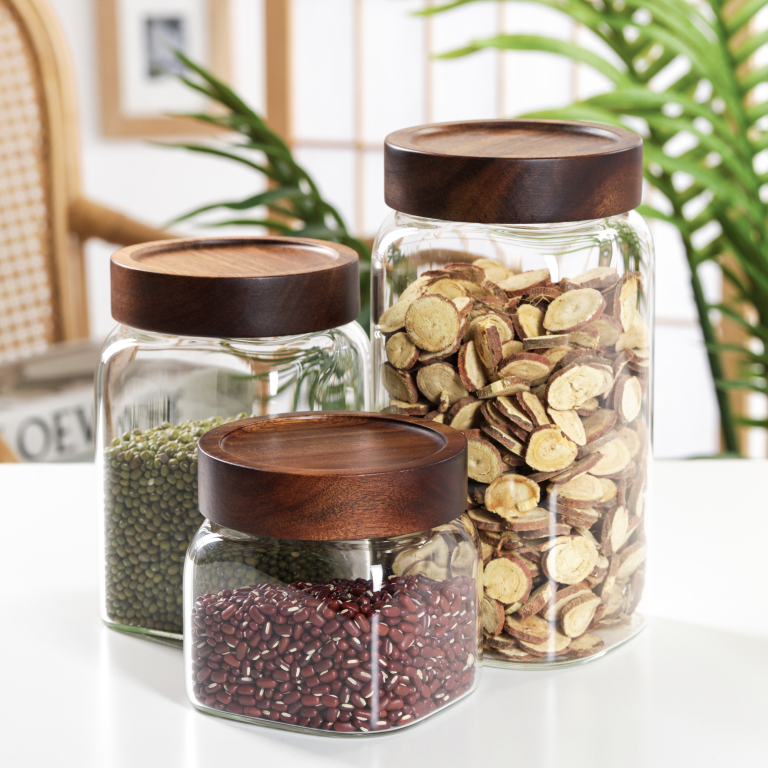
Hemera's glass mason jars are trusted in diverse applications: food preservation (e.g., jams, pickles), laboratory storage (for samples and reagents), and premium packaging (for cosmetics and pharmaceuticals). We partner with global retailers like GreenGoods Stores in Europe and PurePantry Co. in North America, who source our jars for their private-label products. Our collaborations involve joint R&D to tailor jars for specific needs, such as UV-resistant coatings for light-sensitive contents.
FAQ: Answers for Engineers and Procurement Managers
1. How do you ensure jar-to-lid compatibility across batches? We use CNC-machined molds with tolerances of ±0.02mm and conduct batch testing with torque meters to verify seal forces of 10-15 in-lbs, per FDA guidelines for hermetic sealing.
2. What's the maximum thermal shock resistance? Our jars withstand ΔT of 120°C (e.g., from 20°C to 140°C) without cracking, achieved through controlled annealing and thickness uniformity.
3. Are your jars recyclable and food-safe? Yes, they're made from 100% recyclable soda-lime or borosilicate glass, free from lead and cadmium, complying with EU Regulation 1935/2004 and FDA CFR 21.
4. How do you handle custom sizes or designs? We offer modular mold systems, allowing quick changes for volumes from 4oz to 64oz, with a lead time of 4-6 weeks for prototypes.
5. What's your defect rate and quality assurance process? Our defect rate is below 0.1%, ensured by automated inspection using machine vision and statistical process control, with certificates of analysis provided for each shipment.
Conclusion: Elevate Your Jar Standards
Glass mason jars are more than containers—they're guardians of quality. By addressing core manufacturing flaws, Hemera delivers reliability that protects your products and reputation. Don't settle for guesswork; explore our detailed technical whitepaper on advanced glass forming techniques or contact our sales engineers for a personalized consultation. Transform your packaging strategy with jars that truly seal the deal.
