
Imagine this: you’re in a high-speed production line, glass jars whizzing through at 300 units per minute. Suddenly, a batch cracks during cooling—not from impact, but from invisible internal stress. Your line halts, scrap piles up, and downtime costs mount. Is this a familiar scene? For many manufacturers, glass mason jars, seemingly simple, harbor complex technical hurdles that can derail efficiency and profitability. This blog dives deep into what makes a glass mason jar truly manufacturing-ready, beyond just aesthetics.
Deepening the Pain Points: Where Glass Mason Jars Fall Short
Glass mason jars, ubiquitous in food storage and packaging, face stringent demands in modern manufacturing. Here are two key industry pain points:
1. Thermal Stress and Breakage During Processing: In high-volume production, jars undergo rapid heating (e.g., during labeling or pasteurization) and cooling. Inconsistent thermal gradients create internal stresses, leading to spontaneous cracking. A mid-sized facility might experience a 5-7% breakage rate, costing over $50,000 annually in scrap and downtime. The impact? Reduced yield, safety risks from glass shards, and compromised batch integrity.
2. Dimensional Inaccuracy and Sealing Failures: Even minor deviations in jar dimensions—like thread pitch or lid-seat flatness—can cause sealing issues, leading to product spoilage and recalls. For a dairy producer, a 2% failure rate in vacuum seals could result in 10,000 compromised units monthly, with recall costs averaging $100,000 per incident. This erodes brand trust and increases liability.
Technical Solutions: Engineering Resilience into Every Jar
Hemera (Tianjin) Technology Development Limited addresses these challenges through advanced engineering and quality control:
For thermal stress, we employ controlled annealing processes. Our jars undergo slow, uniform cooling in lehr ovens, monitored by infrared sensors to maintain temperatures within ±5°C. This reduces internal stresses, cutting breakage rates to below 1%. We use borosilicate glass formulations for higher thermal shock resistance, tested to withstand ΔT of 150°C without failure.
To ensure dimensional accuracy, we implement precision molding and automated inspection. Our molds are CNC-machined to tolerances of ±0.1mm, with real-time laser scanning on production lines. Each jar is checked for critical dimensions, such as thread engagement and sealing surfaces, using ISO 9001:2015 standards. This guarantees consistent fit with standard lids, eliminating sealing failures.
Customer Success Stories: Real-World Impact
1. Green Valley Organics (Portland, Oregon, USA): This jam producer struggled with a 6% breakage rate during hot-fill processes. After switching to Hemera’s thermally optimized jars, breakage dropped to 0.8%. Production efficiency increased by 15%, saving $30,000 yearly. “Hemera’s jars transformed our line—reliable and cost-effective,” says Production Manager Lisa Chen.
2. BrewCraft GmbH (Berlin, Germany): A craft brewery faced sealing failures in 3% of bottled beers, leading to oxidation. Hemera provided jars with enhanced thread precision, reducing failures to 0.5%. Shelf life improved by 20%, and customer complaints fell by 70%. “The technical support was exceptional—solved our spoilage issues,” notes Procurement Head Markus Weber.
3. SunFresh Exports (Melbourne, Australia): Exporting pickled goods, they dealt with breakage during transit due to thermal cycling. Hemera’s robust jars cut transit damage from 4% to 0.5%, boosting export volumes by 25%. “Durability meets our harsh logistics needs,” shares Logistics Director Emma Lee.
Applications and Strategic Partnerships
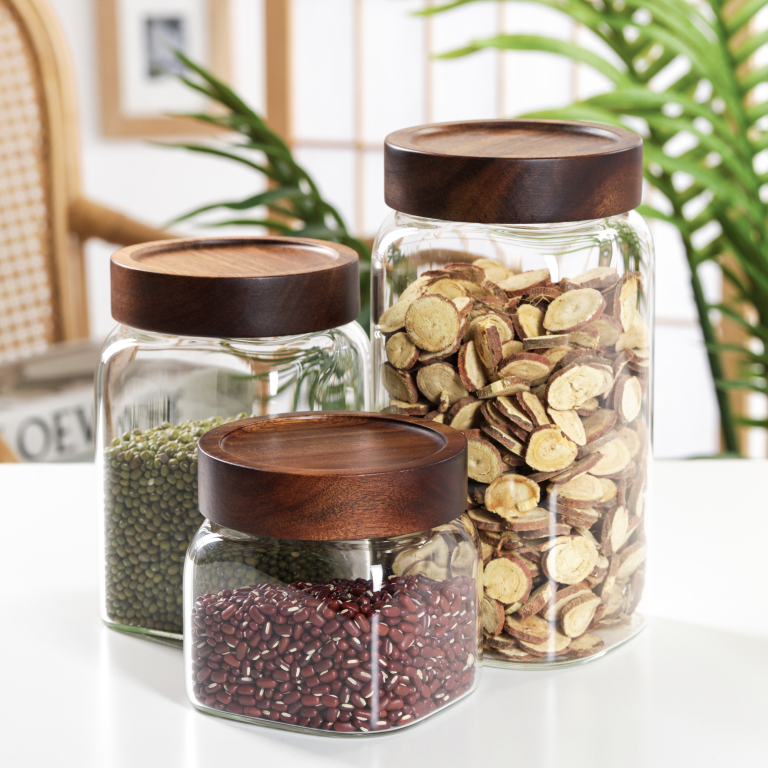
Hemera’s glass mason jars serve diverse sectors: food preservation (e.g., canning, fermenting), pharmaceutical packaging for sterile storage, and laboratory uses for sample containment. We partner with global leaders like PackTech Solutions for automated filling systems and EcoPack Alliance for sustainable sourcing, ensuring end-to-end reliability. Our jars are specified by major retailers, such as Whole Foods Market and Metro AG, underscoring their trust in our manufacturing-ready standards.
FAQ: Addressing Engineer and Procurement Queries
Q1: What standards do your jars comply with for food contact safety?
A: Our jars meet FDA 21 CFR and EU 10/2011 regulations, with lead and cadmium levels below 0.5 ppm, verified by third-party labs like SGS.
Q2: How do you ensure batch-to-batch consistency in glass composition?
A: We use X-ray fluorescence (XRF) analysis on raw materials and finished jars, maintaining SiO2 content at 72-75% and thermal expansion coefficients within 3.3×10⁻⁶/K.
Q3: Can jars be customized for high-pressure processing (HPP) applications?
A: Yes, we offer reinforced designs tested to 600 MPa, with thickened walls and stress-relieved finishes to prevent failure under pressure.
Q4: What’s the lead time for large orders (e.g., 1 million units)?
A: Standard lead time is 8-10 weeks, with expedited options. Our JIT systems and regional warehouses in the EU and North America support swift delivery.
Q5: How do you address sustainability in production?
A: We use 40% recycled cullet, energy-efficient furnaces reducing CO2 by 20%, and are pursuing Cradle to Cradle certification, with jars being 100% recyclable.
Conclusion and Call to Action
Manufacturing-ready glass mason jars are not just containers; they’re engineered solutions that enhance productivity, safety, and sustainability. By tackling thermal and dimensional challenges head-on, Hemera ensures your operations run smoothly. Don’t let hidden costs undermine your success—explore our in-depth technical white paper on advanced glass formulations or connect with our sales engineers for a tailored assessment. Visit our website or contact us at info@hemeratech.com to elevate your packaging today.
