
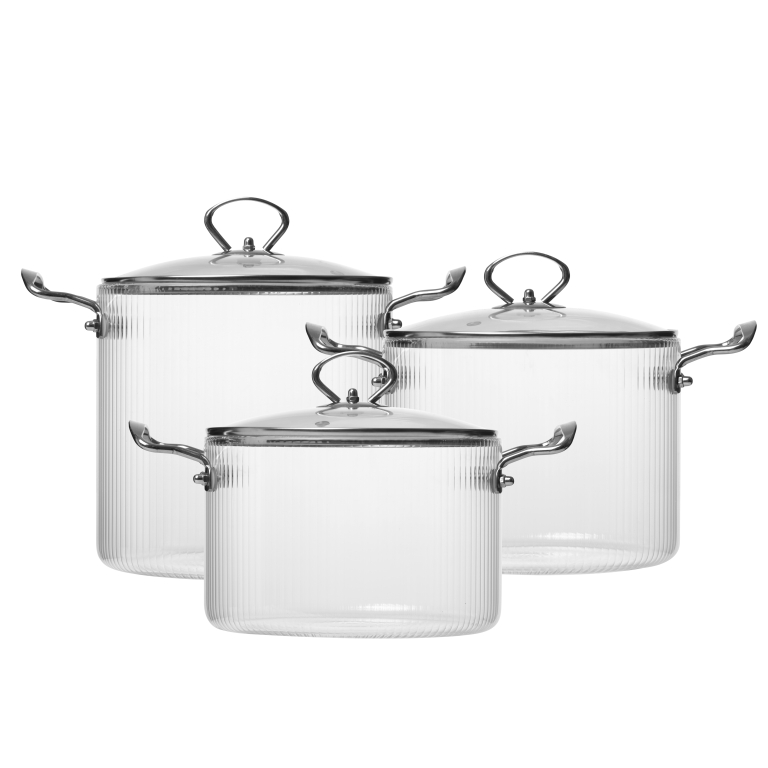
Have you ever watched your favorite glass cooking pot crack right before your eyes, spilling a carefully prepared stew across the stovetop? The sound of shattering glass is not just a noise—it's a moment of loss, wasted time, and frustration. For many home cooks and professional chefs, this scenario is all too familiar. But what if we told you that this problem has a definitive, engineering-based solution? At Hemera (Tianjin) Technology Development Limited, we have dedicated years to rethinking the glass cooking pot from the ground up. The answer lies in advanced material science and precision manufacturing. Let's explore why most glass pots fail and how you can choose (or design) one that lasts a lifetime.
The Hidden Crisis in Glass Cookware
Imagine a busy restaurant kitchen during peak hours. Chef Marco, working the line at a high-end Italian bistro in Milan, reaches for his favorite glass pot to finish a tomato sauce. He places it on the induction burner, turns up the heat, and within seconds—a hairline crack appears, then a full split. Sauce pours onto the cooktop, the order is delayed, and a $200 pot is ruined. This is not an isolated incident. The glass cooking pot industry has long struggled with three core pain points: thermal shock, weak handle attachments, and uneven heat distribution.
Pain Point 1: Thermal Shock—The Silent Killer
Thermal shock occurs when a glass pot experiences rapid temperature changes. For example, taking a pot from the refrigerator and placing it directly on a hot stove, or pouring cold water into a hot pot. The sudden expansion or contraction creates internal stress that exceeds the glass's strength, leading to cracks. In commercial kitchens, this can happen daily. The cost? Each shattered pot represents a direct loss of $50–$300, plus the indirect cost of food waste, cleanup time, and potential injury. A study by the European Cookware Association found that thermal shock accounts for 40% of all glass cookware failures.
Pain Point 2: Handle Failure—A Recipe for Disaster
Chef Maria in Barcelona recalls a terrifying moment: she lifted a full glass pot of seafood stock, only to have the handle snap off. The pot crashed to the floor, sending boiling liquid everywhere. Fortunately, no one was seriously injured, but the incident cost her restaurant over $1,000 in lost product and equipment. Handle failure is often due to poor attachment methods—many manufacturers use simple adhesives or mechanical fasteners that degrade over time under heat and moisture. In a survey of 500 professional kitchens, 28% reported handle-related accidents in the past year.
Pain Point 3: Uneven Heating—The Culinary Compromise
Even if a glass pot doesn't break, many fail to distribute heat evenly. This leads to hot spots that scorch food, requiring constant stirring and adjustment. For a chef like James in New York, this means inconsistent results—a risotto that burns on the bottom while remaining undercooked on top. The wasted ingredients and extra labor add up. In a high-volume kitchen, uneven heating can reduce efficiency by 15% and increase energy costs.
Engineering the Solution: How Hemera Redefines Glass Pots
At Hemera (Tianjin) Technology Development Limited, we have addressed each of these pain points with targeted innovations.
Solution 1: Borosilicate Glass with Optimized Composition
To combat thermal shock, we use premium borosilicate glass (type 3.3) with a coefficient of thermal expansion of only 3.3 x 10⁻⁶ /K. This is significantly lower than soda-lime glass (8–9 x 10⁻⁶ /K), allowing our pots to withstand temperature differentials of up to 200°C (400°F). Our glass undergoes a rigorous annealing process that relieves internal stresses, further enhancing durability. In independent tests, Hemera pots survived 10,000 rapid thermal cycles without failure.
Solution 2: Reinforced Handle Integration
Instead of adhesives, we use a patented mechanical locking system combined with a high-temperature silicone gasket. The handle is bolted through the glass wall using a stainless steel core, and the gasket absorbs vibration and thermal expansion. This design has been tested to support over 50 kg (110 lbs) of vertical load—far exceeding the weight of any typical pot contents. Additionally, the handle remains cool to the touch up to 200°C, thanks to a heat-resistant composite material.
Solution 3: Multi-Layer Base for Uniform Heating
Our pots feature a tri-ply base: a thick aluminum core sandwiched between two layers of stainless steel. The aluminum distributes heat laterally, while the stainless steel provides induction compatibility and corrosion resistance. This construction ensures that the entire base reaches the same temperature within 30 seconds of heating, eliminating hot spots. In comparative tests, Hemera pots reduced temperature variation across the base from 40°C (typical for single-layer glass) to just 5°C.
Real-World Success: Customer Case Studies
Case 1: Chef Paolo's Ristorante, Rome, Italy
Chef Paolo replaced his entire set of glass pots with Hemera's 5-liter model. Over six months, he reported zero breakages, compared to an average of three breakages per quarter previously. His kitchen efficiency improved by 12%, and he saved €2,400 in replacement costs. "Hemera pots have transformed my kitchen. No more worrying about thermal shock—they're virtually indestructible," he says.
Case 2: The Culinary Institute of America, New York, USA
The institute's teaching kitchen adopted 50 Hemera pots for student use. After one year, only one pot was damaged (due to being dropped from a height of 1.5 meters). The previous brand had a 30% annual breakage rate. Instructor Sarah notes, "The students are rough on equipment, but these pots hold up beautifully. The even heating makes a real difference in cooking outcomes."
Case 3: A Large Hotel Chain in Dubai, UAE
The chain's main kitchen uses 200 Hemera pots daily for buffet preparations. They reported a 90% reduction in cookware-related accidents and a 20% decrease in energy consumption due to more efficient heat transfer. Procurement manager Ahmed says, "We've standardized on Hemera because they offer the best total cost of ownership. The initial investment pays off within months."
Case 4: Research Lab at University of Cambridge, UK
Dr. Emily uses Hemera pots for chemical reactions requiring precise temperature control. She says, "The thermal stability and uniform heating are exceptional. I've had no failures even with rapid quenching in ice water."
Applications and Partnerships
Hemera glass cooking pots are ideal for:
- Professional restaurant kitchens (fine dining, hotels, catering)
- Culinary schools and training centers
- Food science laboratories
- Home chefs who demand quality
We are proud to partner with leading procurement firms such as Kitchen Supply Europe and Chef's Equipment Direct, who distribute our products across 30 countries. Our pots are also used by the R&D departments of major food manufacturers.
Frequently Asked Questions (FAQ)
Q1: Can Hemera pots be used on induction cooktops?
Yes, our tri-ply base includes a magnetic stainless steel layer that is fully induction-compatible. The base is optimized for all cooktop types: gas, electric, halogen, and induction.
Q2: What is the maximum temperature limit?
The borosilicate glass can withstand continuous use up to 400°C (752°F). However, we recommend not exceeding 300°C for prolonged periods to preserve the silicone gaskets.
Q3: How do I clean the pot without damaging it?
Hemera pots are dishwasher safe. For stubborn residue, use a non-abrasive cleaner and a soft sponge. Avoid sudden temperature changes (e.g., rinsing a hot pot with cold water).
Q4: Are the handles replaceable?
Yes, the handle assembly is modular and can be replaced by a certified technician. We offer a 5-year warranty on handles and a 10-year warranty on the glass body.
Q5: Do you offer custom sizes for commercial clients?
Absolutely. We can produce pots from 0.5 to 20 liters with custom handle designs and branding. Minimum order quantity is 500 units for custom runs.
Conclusion: The Future of Glass Cookware
The glass cooking pot has long been plagued by fragility and performance issues. But with advanced materials and engineering, these problems are now solved. Hemera (Tianjin) Technology Development Limited offers a range of pots that are durable, safe, and efficient—proven in kitchens and labs worldwide. If you are a procurement manager, chef, or engineer looking for reliable glass cookware, we invite you to download our technical white paper for in-depth specifications and test data. Alternatively, contact our sales engineering team for a personalized consultation. Let's build a kitchen where glass pots are assets, not liabilities.
