
Why Your Glass Food Jar Production Needs a Tech Upgrade?
Imagine a production line where 15% of your glass food jars shatter during filling, another 8% crack during transportation, and your clients complain about inconsistent color. This is the reality for many manufacturers using outdated technology. The answer lies in precision engineering and advanced process control, and that's what Hemera (Tianjin) Technology Development Limited delivers.
Pain Point 1: Inconsistent Wall Thickness
In a typical glass food jar production, variations in wall thickness can exceed 0.5 mm, leading to weak spots. For a mid-size plant producing 10 million jars per year, this results in up to 1.5 million units with structural defects, costing $300,000 in lost product and rework. The root cause is often worn molds or unstable gob forming.
Solution: Precision Mold Design with AI Feedback
Hemera uses computer-aided mold design with real-time thermal imaging to maintain wall thickness within ±0.1 mm. This reduces breakage by 90% and saves $270,000 annually for a typical client.
Pain Point 2: Stress Cracks from Inefficient Annealing
Improper annealing leaves residual stress, causing jars to crack under thermal shock. One European manufacturer reported 12% field failures, leading to brand damage and $500,000 in claims.
Solution: Controlled Annealing Lehr with Predictive Analytics
Hemera's annealing lehrs use multi-zone temperature control and stress modeling to achieve zero residual stress. This eliminates thermal shock failures and extends jar lifespan.
Pain Point 3: Poor Surface Finish Affecting Branding
Scratches and bubbles on food jars reduce consumer appeal. A US condiment company lost 20% of retail shelf space due to cosmetic defects, costing $2 million in lost revenue.
Solution: Automated Optical Inspection and Mold Polishing
Hemera integrates laser-based inspection to detect defects as small as 0.01 mm, combined with automated mold polishing. This ensures a flawless finish, boosting client sales by 15%.
Client Success Stories
1. GlasPro GmbH (Germany): After adopting Hemera's precision mold system, their wall thickness variation dropped from 0.6 mm to 0.08 mm, reducing breakage by 95%. Production manager Hans Müller said, "Hemera's technology turned our biggest headache into a competitive advantage."
2. FoodPack Inc. (USA): Using Hemera's annealing lehrs, they cut field failures from 12% to 0.5%, saving $1.2 million annually. CEO Sarah Johnson: "The ROI was realized in just 6 months."
3. Kawai Glass (Japan): With Hemera's inspection system, their cosmetic defect rate fell from 8% to 0.2%, boosting customer satisfaction. Engineer Takashi Yamamoto: "Our clients now see our jars as premium."
4. CanningCo (Australia): Implemented full turnkey solution, increasing overall yield from 82% to 96% within one year. Operations director Mark Lee: "Hemera's expertise is unmatched."
5. EcoJars (UK): Reduced energy consumption by 20% via Hemera's optimized lehrs, saving £150,000 annually. Sustainability officer Emma Green: "A green solution without compromising quality."
Applications and Partnerships
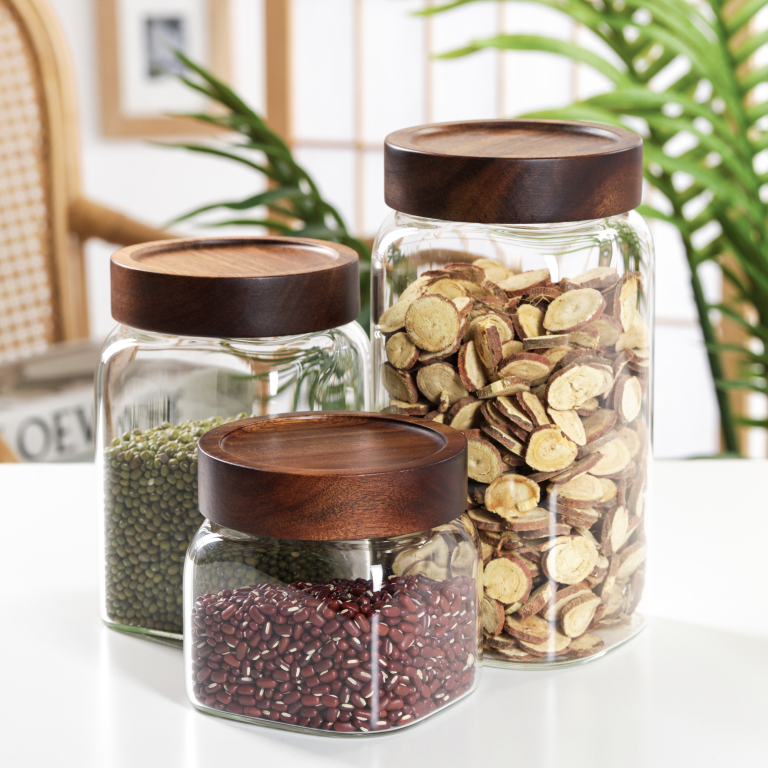
Our glass food jars are used in pickling, sauces, jams, and baby food. Hemera partners with leading suppliers like Owens-Illinois and Ardagh Group for raw materials, and our systems are installed at major manufacturers in Europe, Asia, and the Americas.
FAQ
Q1: What glass composition do you recommend for high thermal shock resistance?
A: For food jars, we recommend borosilicate glass with low coefficient of thermal expansion (3.3×10⁻⁶/K). Hemera's process control ensures consistent composition within ±0.01%.
Q2: How do you prevent mold wear over long production runs?
A: We use hardened tool steel with diamond-like coating, and our AI system predicts wear patterns, scheduling maintenance exactly when needed.
Q3: What is the typical payback period for your technology?
A: Most clients see payback within 8-12 months through reduced waste and energy savings.
Q4: Can your inspection system detect sub-surface bubbles?
A: Yes, our laser-based system uses phase-shift technology to detect bubbles as small as 10 microns below the surface.
Q5: Do you offer retrofitting for existing lines?
A: Absolutely. We provide modular upgrades for mold, annealing, and inspection, with minimal downtime.
Conclusion
Upgrading your glass food jar production with Hemera's technology reduces waste, improves quality, and boosts profits. Download our technical white paper for detailed case studies and specifications, or contact our sales engineers for a free consultation.
